
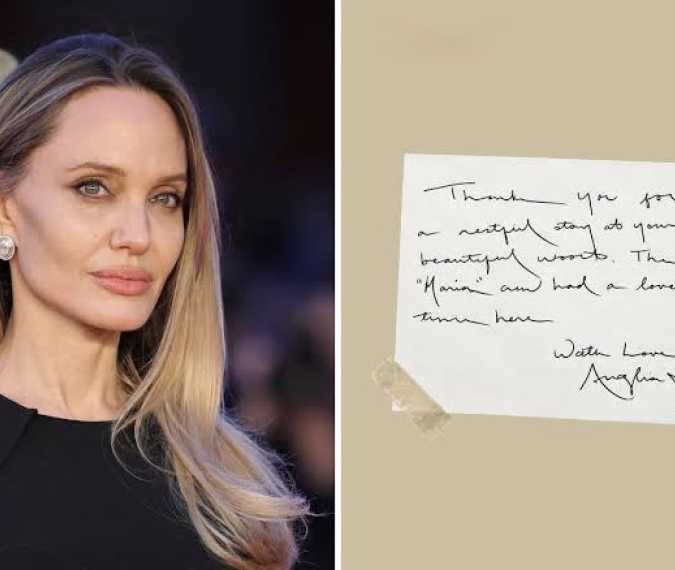
Angelina Jolie’s Handwritten Thank-You Note to Greek Hotel Staff Baffles the Internet
When Angelina Jolie thanked the staff at a Greek resort in 2023, her message was a simple thank-you. Three years later, it drew fresh attention for an unexpected reason: readers could not agree on what her handwriting said.
The note resurfaced on social media in September 2026, prompting a lively discussion about the actress’s flowing cursive. Some readers struggled to separate the words, while others said they understood the message immediately.
The story began during Jolie’s stay at Aldemar Olympian Village in western Greece, where she was working on Maria, the film in which she portrays opera singer Maria Callas. The resort shared her handwritten thanks on October 24, 2023, and Greek media reported on the gesture at the time.
Contemporary reports transcribed the message as thanking the hotel for a restful stay and saying that the Maria cast had enjoyed their time there. Although later versions differ slightly in their reading of individual words, the sentiment is straightforward: Jolie appreciated the hospitality she and her colleagues received.
“Thank you for a restful stay at your beautiful resort. The ‘Maria’ crew had a lovely time here. With love, Angelina.”
The renewed attention shifted the focus from the message to its presentation. According to HOLA!, citing BuzzFeed, one X post featuring the note attracted more than 8.4 million views. Reactions ranged from complaints about difficult penmanship to suggestions that familiarity with cursive made the writing easy to follow.
That disagreement also sparked a broader conversation about reading handwritten text in an increasingly digital world. Some commenters framed the reactions as a generational divide; others felt the difficulty came down to Jolie’s individual writing style. The responses alone, however, cannot establish whether cursive-reading skills are declining.
For all the debate over its loops and connected letters, the note carries an uncomplicated message. What began as a private expression of gratitude has become a public reading challenge—one whose meaning is warmer than the argument surrounding it.